Monday, February 1, 2016

Day 32: John M. Byrne's "Cartooning: The Best One-Stop Guide to Drawing Cartoons, Caricatures, Comic Strips, and Manga"

Quick Overview
 
Level: Beginner
Tone: Introduction Guide
Pages: 191
Published: 2008
Arbitrary Rating: 4/5
Plan to Reread: No


My Opinion:

Phew, that's a mouthful right?  John M. Byrne's "Cartooning" is a crash course in a variety of artistic disciplines that you can find in that crazy title.  As an example, chapter 7 is on caricatures and is about twenty pages long with multiple illustrations on most pages.

I really like this approach for beginners because it's easy to follow along with the visuals and there's just enough instruction to get your feet wet.  That being said, if you're looking to improve on any of these styles you're going to need way more than the one or two examples provided in this book.

The chapter on humor, using puns, and generating interesting ideas was probably my favorite.  A lot of books take the approach of showing you a pretty picture and then breaking it up into a few easy to follow steps.  Byrne gives advice on tools to use, writing tips, and observation techniques to choose the best details when translating from real life to cartoon.

While the contents of this book may not carry you as far as a more academic text, it has plenty to offer in an enjoyable and colorful presentation.  That's one of my biggest gripes so far.  Most of the books I've been reading through are so heavily focused on the use of charcoals and pencils that they don't bother to include any colored illustrations.  Looking at 100+ pages of black and white can be a real drag, so I'm happy to find a guide that goes that extra step.

Friday, January 29, 2016

Day 29: Week 5 Summary

This wraps up the fifth week of regular drawing practice. I've definitely plateaued with the improvement I can see in my sketch work. It's also been difficult to lock in on a single focus since the book I'm reading this week leans more towards writing and format techniques for comics.

The expression exercises have been pretty interesting. It's equal parts fun and frustrating to see how drastically the feel of a face can change when you shift an eyebrow or tweak a pupil even a little bit. This is definitely an area that can benefit from throwing tones of effort and assembly line style repetition.  The characters I studied came from random Google image searches, but I'd like to give credit to dA's OwlyGem, Monecule, Octeapi to name a few.


My early approach to anatomy is copying studies that other people have already drawn. I want to work from my copy of "Atlas of Human Anatomy for the Artist", but I feel like that's still a little out of my league right now.


I did a lot of gesture drawings using artists.pixelovely.com.  I haven't worked down to one minute gestures, but the five minute timer is a pretty good pace right now.  I'd like to work gesture drawings into my daily ritual to familiarize myself more with the natural movements of the human body but that might be a ways off yet.


Metrics

Pages Read This Week 102
Total Pages Read Since Launch 400
Books Completed Since Launch 6
Total Tutorial Run-time 2 hours 44 minutes
Days Since Launch 29
 - Active Days (1 hour or more of practice) 29
Drawing Time This Week 7 hour 10 minutes
Drawing Time Total 30 hour 2 minutes


* I'm considering Friday to be the end of the week for tracking metrics so that it lines up with my summary posts.

** I had to use a some fuzzy math to figure the page count for some of my Kindle books since they only have location tagging.

Wednesday, January 27, 2016

Day 27: Tutorials by Evan Burse


Here's a quick blurb on Evan Burse from The Cartoon Block's official website.

Evan has been an animation professional for over 10 years. He’s worked on such shows as Batman: The Brave and the Bold, Black Panther, Marvel’s Hulk and The Agents of S.M.A.S.H., and Teen Titans.

I have been using Evan's tutorials on and off for years.  The first one I followed was his guide on How To Draw Superhero Chest (Torso) and I've run through it several times trying to commit the method to memory.


Granted, I'm no Michelangelo when it comes to anatomy but this is a pretty decent reproduction for a guy who had no traditional training in drawing the human body.

His channel's big appeal are the how to's for popular characters.   Below you can see the Krillin and Vegeta head shots I finished from his tutorials.  They turned out much cleaner than the  other two that I copied over from some comic books I had laying around my desk.


For today's exercise, I'm going to run through the Superboy tutorial a few times and see how well it turns out.  You can find that link here:  How To Draw Superboy.

I'd also like to point out that it was the tutorials at Cartoon Block that introduced me to Col-Erase pencils and they're awesome.  They lay down much smoother and more consistent color than any other brand I've tried to use so far. 

Monday, January 25, 2016

Day 25: Klaus Janson's "The DC Comics Guide to Pencilling Comics"


Quick Overview
 
Level: Advanced
Tone: Industry Guide, Reference
Pages: 128
Published: 2001
Arbitrary Rating: 4/5
Plan to Reread: Yes


My Opinion

This week I'm going to be working through my Kindle version of Klaus Janson's"The DC Comics Guide to Pencilling Comics." After drawing a bajillion shaded circles it's nice to finally be seeing something that resembles a finished comic.

The guide provides a lot of interesting insight into the comic creation process and the underlying principles needed to be successful.  Part one includes a handful of crash courses in fundamental art techniques like perspective, vanishing points, anatomy and so on.  Part two has some meaty explanation of writing techniques, panel layout, and story flow.  Part three covers penciling techniques and tips for breaking into the industry.

The only drawback is that this is primarily a theory crafting book.  Janson uses a number of comic pages to illustrate story telling techniques but there is a ton of reading for a book that is advertised as a guide to penciling.  That shouldn't be taken as a negative though.  If you've already mastered the basics of drawing you don't really need tons of step by step illustrations to follow along.

This was a fun read even for a beginner, but it is better suited for a more advanced audience.  I'll probably be reading through the whole DC series at least twice to get all of the useful nuggets of advice out. 

Friday, January 22, 2016

Day 22: Week 4 Summary

This is my first week without structured daily lessons.  I did a little speed reading to wrap up "Drawing for the Absolute Beginner".  I mentioned the reason in my Monday book review, but if you're just catching up on the summaries this is why:


This is one of the demonstrations they provide for absolute beginners to practice drawing.  I know two people who have gone to art school that can't draw at this level.  It's ten kinds of crazy to suggest someone who just started learning to draw should start with this kind of exercise.


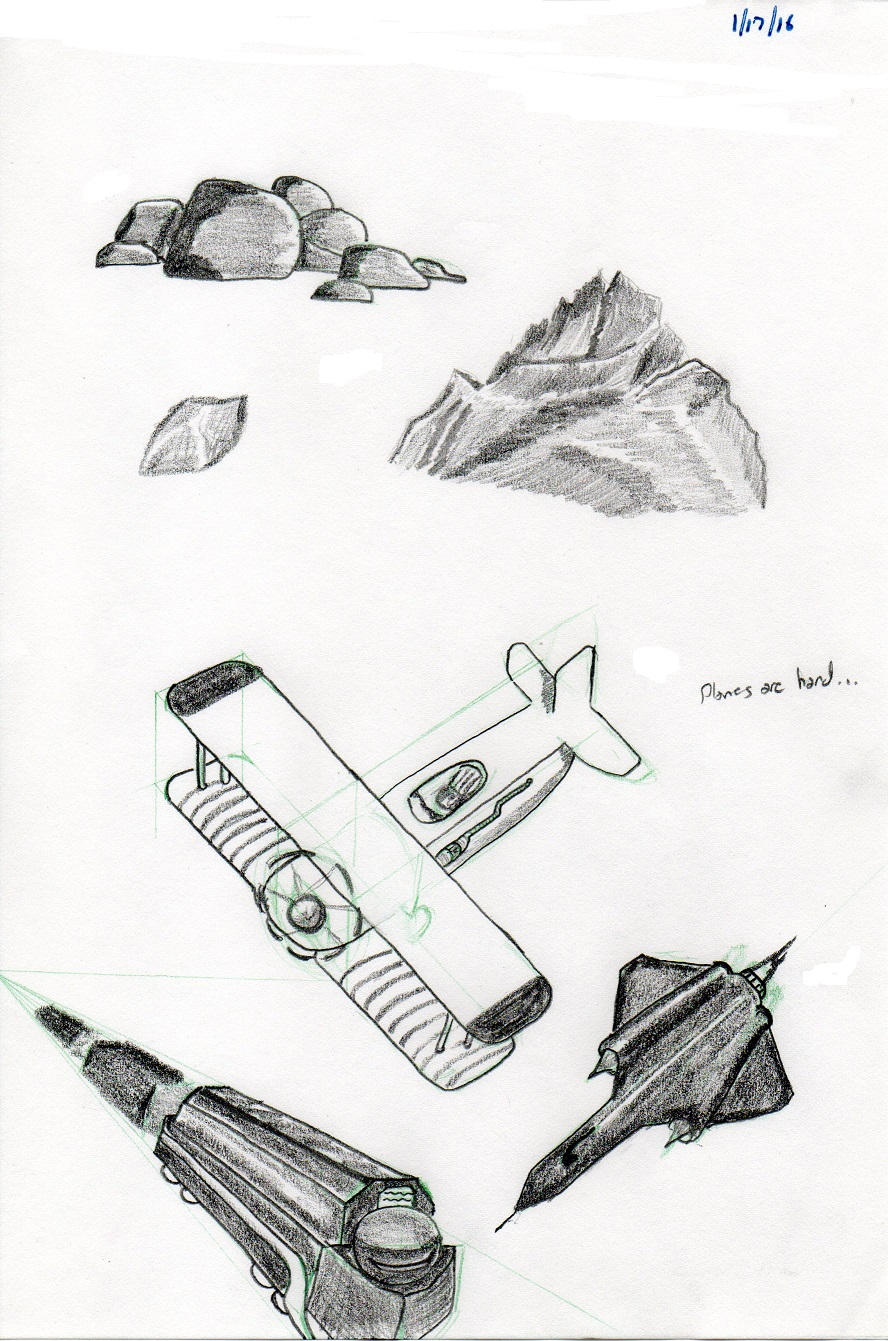
The earlier lessons covered rocks, planes, and trains which were only a little easier to emulate at my current level.  It's difficult enough to get the perspective, line work, and value shading right at this point.  I don't know why every example has to be jam packed with details.


I got bored with the impossible exercises and switched gears to trace from one of my comics, Giant-size Little Marvel: AVX (2015) #1. It didn't turn out as clean as I was hoping but it was way more fun to draw than anything I've been studying so far.


I took one last stab at learning heads from the Absolute Beginner's book before shifting gears to Klaus Janson's "The DC Comics Guide to Pencilling Comics" and some random head tutorials I found on dA.


My first anatomy study in a very long time, also from the DC guide.  I'm kicking myself for dropping the studies for so long because I had this all committed to memory before.  Now I can't draw a decent action pose even if I dump hours into the sketch.


If the anatomy sketches look a little beefy, that's because I'm following a guide for DC comic super heroes.  They don't really show how to draw someone with a willowy frame.  I dig it though.  It's a good read so far and this is pretty much an industry standard for American comics so it's definitely worth improving on.


Metrics
 
Pages Read This Week 150
Total Pages Read Since Launch 298
Books Completed Since Launch 3
Total Tutorial Run-time 2 hours 16 minutes
Days Since Launch 22
 - Active Days (1 hour or more of practice) 22
Drawing Time This Week 7 hour 15 minutes
Drawing Time Total 22 hour 52 minutes


* I'm considering Friday to be the end of the week for tracking metrics so that it lines up with my summary posts.

** I had to use a some fuzzy math to figure the page count for some of my Kindle books since they only have location tagging.

Wednesday, January 20, 2016

Day 20: Tutorials by David Revoy


I found David Revoy's Pepper & Carrot comic on imgur last year and followed the internet crumbs back to his home page.  He has a very interesting philosophy on creating comics, using open-source software, and closing the gap between creator and audience.  He even encourages people to use his characters to make a profit so long as they give him credit.  So far I haven't found anyone else taking this approach and I really like it.

I also love that his web comics are translated into English and Japanese.  Reading the same comic in both languages is really great practice for me.

Back to the meat and potatoes of today's post.  David's site has a ton of great tutorials here and on his YouTube page, https://www.youtube.com/user/DeevadRevoy.  I don't have a lot to show for the hours I've thrown at Krita but after watching a few of his tutorials I now know how to customize the tool bar to make the smoothing tool easier to find, how to easily turn my sketch into a blue tone that's easier to ink over, and how to adjust saturation to remove left over marks from the sketch work.

I hope my comic can be even half as well produced as Pepper & Carrot.  I may even have to break out the Japanese books again so I can tackle the bilingual approach.


Monday, January 18, 2016

Day 18: Mark and Mary Willenbrink's "Drawing for the Absolute Beginner"


Quick Overview
 
Level: Intermediate
Tone: how to, reference
Pages: 128
Published: 2006
Arbitrary Rating: 3/5
Plan to Reread: Yes


I have a copy of the 2006 version of, "Drawing for the Absolute Beginner: A Clear & Easy Guide to Successful Drawing (Art for the Absolute Beginner)".  Fair warning, it's not nearly as beginner friendly as it sounds.

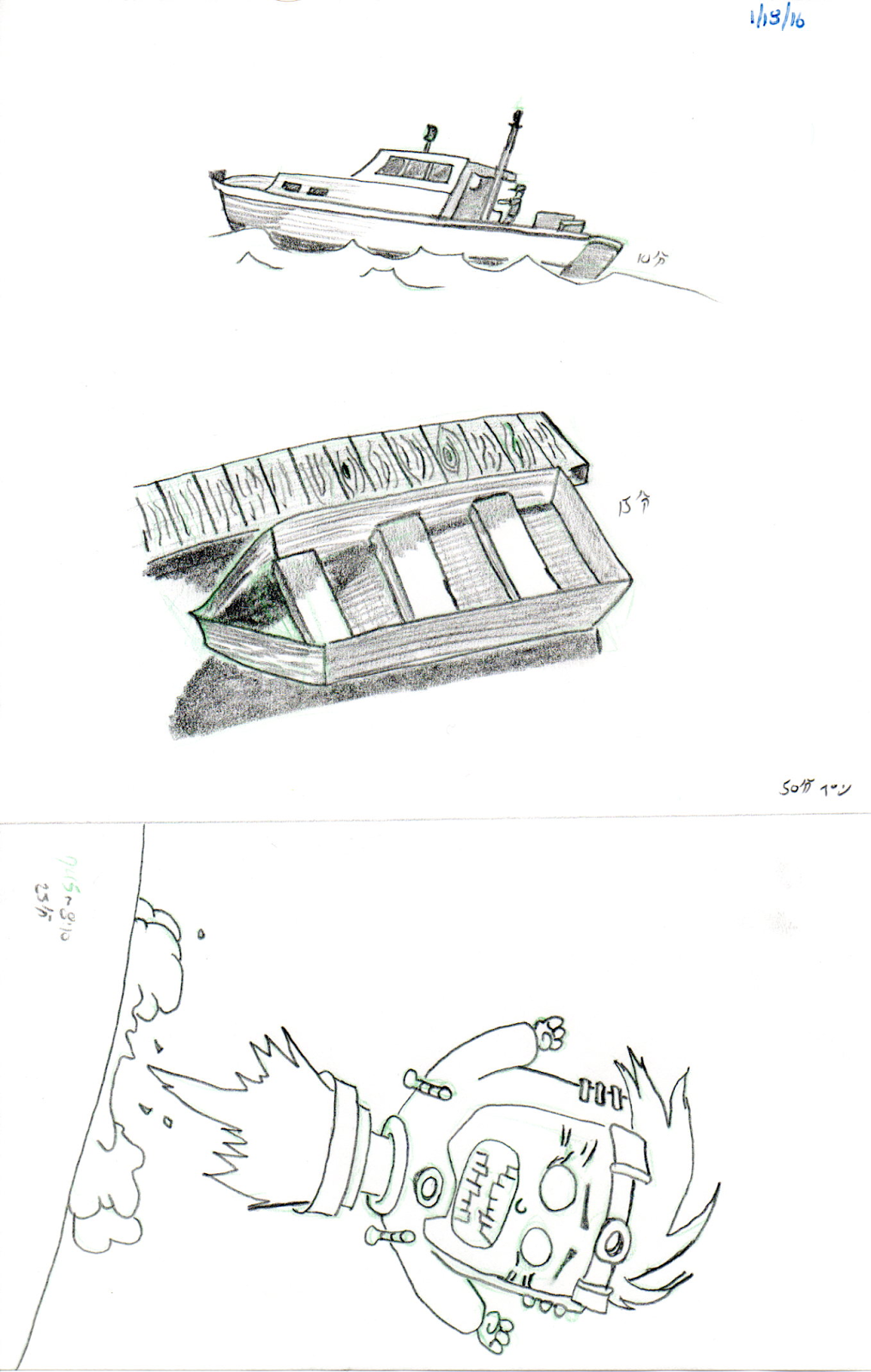
This book is broken down into six chapters:  Sketching and Drawing, Principles of Good Drawing, Values, Practice the Techniques, Composition, and Let's Draw.  Each chapter has a series of "mini-demonstrations" that are supposed to illustrate the focus of the chapter.  For example, the demonstration I'm working on today is from Chapter 4 which lays out how to draw a boat in five steps.

I have a problem with this approach because it's the class 'Draw one circle, draw another circle, add details' approach to drawing that is impossible for a real beginner to follow.  Everything from the structure to the final picture is a little too perfect for someone who is just starting out.  Mark Kistler ended each lesson with pictures done by his own students and I could look at those and think, "Hey, my picture looks about that good.  I must be on the right track."

From my perspective, this book is better for reference material than as a beginners book.  If you're trying to draw a boat, plane, car, etc you can find good examples in here.  But if you're trying to learn as an absolute beginner this book just lacks structure.  It's difficult to settle into a routine since the demonstrations bounce around and don't really build on one another.

There are good points to pick up in this book, but you'll have to bring some experience and a lot of effort to get the full benefit.  I plan to run through it again at least one more time a few months from now to make sure I've given it a fair shot.